
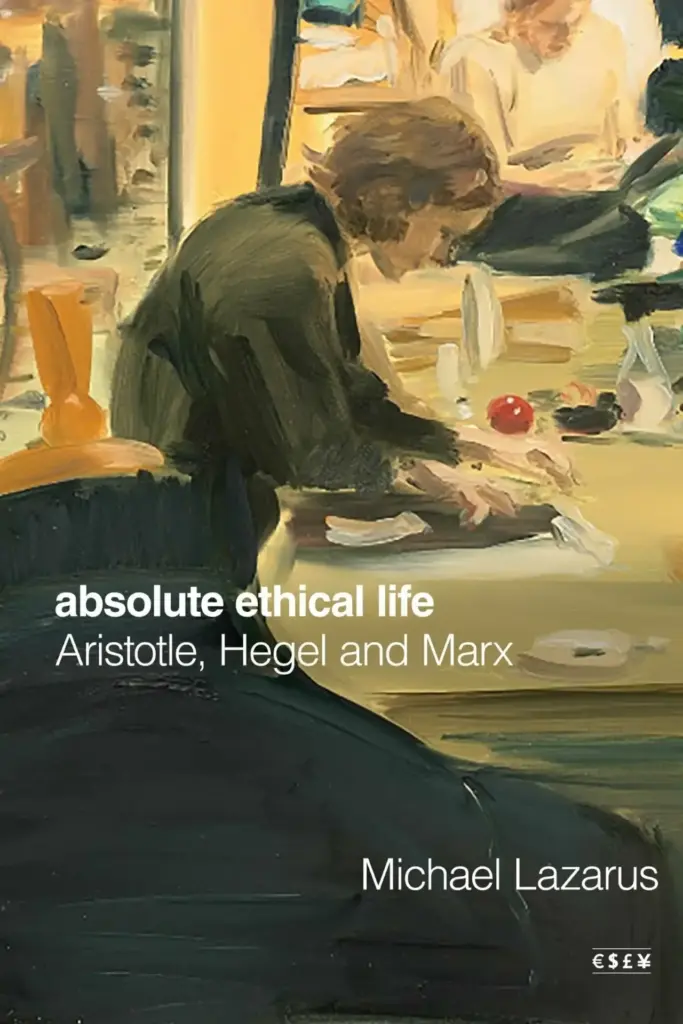
The primary focus of Absolute ethical life by Michael Lazarus is to elevate the social as a central category in philosophical ethical thought. Life, experienced through and within human otherness, is often disregarded by the individualistic moral framework of bourgeois ideology. For Lazarus, this dimension must be reclaimed.
The twenty-first century, particularly in the wake of the COVID-19 pandemic, has witnessed the disintegration of the public sphere, pushed aside from its political center (Lazarus, 2025, p. 19). Freedom has become a mere formality, contrasted with structural oppression. In response to the resurgence of the far right, the need for a critical social theory has become increasingly urgent. Lazarus contends that genuine equality cannot emerge under the alienating mechanisms of capital. Marx contributes to this critique, though the passage of time (more than 150 years) may threaten the relevance of his analysis to the present. Nevertheless, while economic theory may age, ethical inquiry preserves a sense of permanence, continuing to elucidate the distinction between good and evil—an insight still present in Aristotle’s philosophy. This is precisely the objective of Lazarus’s work: to explore the possibility of leading an ethical life through the philosophical legacies of Aristotle, Hegel, and Marx.
Among the thinkers discussed, only Marx fully confronts the true face of capitalist production and ideology. This raises a natural question: if Marx’s critique is ethically sufficient, why look further into the past? According to Lazarus, the point is not Marx alone but the frequent misinterpretations of his work; a misreading that can be clarified through engagement with two major predecessors. He thus begins by presenting the central tenet of Marx’s analysis. For Lazarus, “the value-form is Marx’s most significant contribution to critical social theory” (p. 3). This concept, though complex, can be outlined in more accessible terms.
The worker, immersed in the routines of capitalist labor, inadvertently surrenders part of his being through the act of commodification. A portion of the labor performed is not remunerated through wages, resulting in surplus value. The commodity, then, becomes a lifeless container for a vital human capacity: the ability to transform nature and to shape the world through intellectual and physical activity, thereby producing a second, humanized nature. Under conditions where laborers own their instruments of labor, their work can be exchanged freely in the market, allowing them to retain most of the value they create. Under capitalism, however, workers have been alienated from their means of production and can participate in the market only by selling their labor power. In this arrangement, typical nineteenth-century wages merely cover bodily subsistence, while capitalists appropriate the surplus value that ethically belongs to the laborers.
For Marx, labor is the transformation of matter through the use of thought and tools. Commodities express a remarkable capacity to meet human needs. As material objects bear the imprint of rational activity, they become petrified human relations. This is their secret: commodities satisfy because they are produced by socially embedded labor—labor that becomes work through the active transformation of nature, though not fully compensated for the laborer. In this process, workers lose part of their being, becoming alienated from themselves. A paradox thus emerges: workers give themselves in a socially oriented labor process, while the capitalist appropriates the product for personal gain. The capitalist figure, saturated with being—an excess of human essence made possible by the appropriation of others’ labor—engorges himself with the illusion of self-sufficiency. In this state, he is proud of a superior individuality, defined by the possession of commodities.
Robinson Crusoe becomes the archetype of Enlightenment bourgeois ideology: the belief that any man, if he tries hard enough, can make himself. Poverty, under this view, is merely a moral failure. Alone on a deserted island, the bourgeois man is believed capable of surviving and even thriving by virtue of his reason and moral discipline. Fundamentally, he is alone with God. It is no coincidence that Max Weber insisted on the relationship between Protestantism and capitalism. Feudalism fostered a sense of community centered on the church, where the priest served as vicar and pastoral guide for a democratic moral community. The priest, like a psychoanalyst, mediates individual guilt, but repentance remains a social act.
The Protestant conception of the good is relatively straightforward: one’s internal moral compass aligns with the will of a hermeneutically interpreted God. Later, Calvinism introduces the notion of the predestination of wealth, implying that the ownership of commodities is a sign of moral righteousness. Accordingly, the moral apex of the bourgeois worldview becomes Kant’s Critique of Practical Reason, where an a priori moral law, contentless by nature, justifies action so long as it can be universalized through rational argument. Under capitalism, the universal moral law becomes the imperative to possess property. Possession, in this framework, defines ethical value. Commodity owners, operating as market actors and “slaves of possession,” become the fuel of capital, which Lazarus characterizes as a metaphorical vampire (p. 6). In such a context, ethical life equates the highest good with the act of owning.
Thus, any viable alternative to capitalism must reestablish being at the center of human existence. For Marx, being is always embedded in a complex network of social relations. To be is to be among others, and so sociality must be reinstated. However, such a reinstitution is not possible without recognizing the ethical frameworks of Aristotle and Hegel.
This triadic relationship is reflected—albeit synthetically—in the book’s title. As Lazarus writes, all three philosophers “assess social life in terms of the normative relations of human activity and rational institutions in which human beings might be free” (p. 12). To Hegel’s concept of Sittlichkeit, an ethical structure grounded in social institutions, Lazarus adds Aristotle’s eudaimonia, the realization of a virtuous life lived for and within the polis. Both converge in Marx’s critique of bourgeois economic categories. Hence, the formulation of “absolute” ethical life: a synthesis of Greek virtue ethics, Kantian individual moral autonomy, and Hegelian institutional ethics.
Yet, these philosophical convergences do not grant Marx absolute authority to judge the present. Lazarus instead finds relevance for Marxist ethics in the work of his twentieth-century critics. This methodological reversal explains the book’s structure, which proceeds from the present toward the past.
Following an informative and dense introduction that sufficiently establishes the scope of the book, the first section addresses two prominent contemporary critics of Marx: Hannah Arendt and Alasdair MacIntyre. Even a casual reader of Marx may find these critiques superficial and wonder in whose hands the legacy of Marxism has been entrusted. Lazarus, however, cannot perform miracles; he requires some anchor in the present to ground a Marxian ethical reading. The superficial nature of these critiques nonetheless serves to highlight the inherently social and humanistic dimensions of Marxist ethics. According to Arendt, modern political regimes have reduced politics to a matter of individual concern. This is a central argument in The Human Condition (1958), where she suggests that the modern category of the social obscures a more fundamental relationship between the public and private spheres. As a nineteenth-century property holder, the contemporary political subject acts primarily through the market, displacing the notion of political action as a transformative force. In her view, Marx misunderstood the distinction between labor, work, and action, reducing homo faber to animal laborans (Arendt, 1998, p. 87).
In The Human Condition, Arendt claims that Marx’s main preoccupation is labor, understood as the mechanical effort of securing material subsistence. By contrast, work, defined as the active transformation of nature and the creation of a second, humanized world, loses prominence. So does political action. However, even a cursory reading of Marx’s 1844 manuscripts dispels this interpretation. Marx is primarily concerned with work as an ontological process that not only transforms nature but also shapes the worker. An exclusive emphasis on political action devoid of material transformation, Lazarus argues, reflects the illusions of social democracy—abstract musings detached from the material base, and ultimately complicit with capitalist ideology. In contrast, Marx’s notion of unalienated labor combines the transformation of nature with genuine political action.
MacIntyre’s critique, whether intentionally or not, falls into a similarly superficial line of argument. In After Virtue (1981), the former Marxist philosopher challenges what he perceives as the ethical emptiness of Marxism. If bourgeois morality has been thoroughly dismantled by critique, he asks, why prefer socialism? Can morality survive without a stable foundation? According to MacIntyre, capitalist ethics must be grounded in some form of moral justification. Yet for Marx, there is no fixed human nature; it is historically produced. This historicism makes the formulation of universal moral laws untenable. In this view, a radical critic of the past may leave us morally empty-handed. MacIntyre, in contrast, insists that virtue must be rooted in traditions (MacIntyre, 2007, p. 222).
However, morality is itself historically determined. Aside from basic material needs, definitions of good and evil have often been imposed from above, whether through monarchy or parliamentary law. After Virtue fails to fully account for the material basis of morality and its institutional manifestations. Despite this, both MacIntyre and Arendt share a diagnosis of the arid individualism at the heart of modern ethics. In response, they turn back to Aristotle’s Nicomachean Ethics and the idea of ethics embedded in communal life.
The second part of Lazarus’s book traces the history of ethical life, acknowledging that both Arendt and MacIntyre portray Marx as “a waystation and a roadblock between past and future traditions” (Lazarus, 2025, p. 119). Chapter 4, in particular, explores the enduring Robinsonian myth of the self-sufficient man. Rooted in social contract theory and Kantian Moralität, modernity canonized the ideal of individuality, where an inner moral law serves as a via regia for discerning good and evil.
Part three is the densest section of the book. Contrary to the unfounded Althusserian division between a young, humanist Marx and an older, economistic and deterministic Marx, Lazarus demonstrates, within an ethical framework, the continuity of thought that links the 1844 manuscripts, the Grundrisse, and Capital. In fact, the labor theory of value serves as the cornerstone for understanding how even seemingly abstract economic and political arguments are, at their core, ethical statements.
Although not addressed within the scope of Lazarus’s book, it would be worthwhile to consider ethical interpretations developed by early twentieth-century Marxist thinkers such as Georg Lukács and Antonio Gramsci. Lukács, in History and Class Consciousness, analyzes the concept of reification, by which human relationships are transformed into relations between things. While not framed explicitly in ethical terms, the idea carries significant ethical implications. Gramsci, in the Prison Notebooks, offers valuable reflections on the organic nature of Marxist intellectuals, whose role cannot be understood independently of moral considerations.
Alienation, Lazarus suggests, is a form of theft. If the biblical figure of Barabbas escaped punishment, the theft of human essence represents something far graver—an ontological and etymological annihilation of the subject. There can be no individual redemption, only collective redemption. The search for, and restoration of, sociality as the essence of humanity is thus an act of redemption of the highest order. Marx is presented as the apostle of this transformation, and the agents of its realization are ourselves.
References
Arendt, H. (1998). The human condition. University of Chicago Press.
Lazarus, M. (2025). Absolute ethical life: Aristotle, Hegel, and Marx. Stanford University Press.
MacIntyre, A. (2007). After virtue: A study in moral theory (3rd ed.). University of Notre Dame Press.


