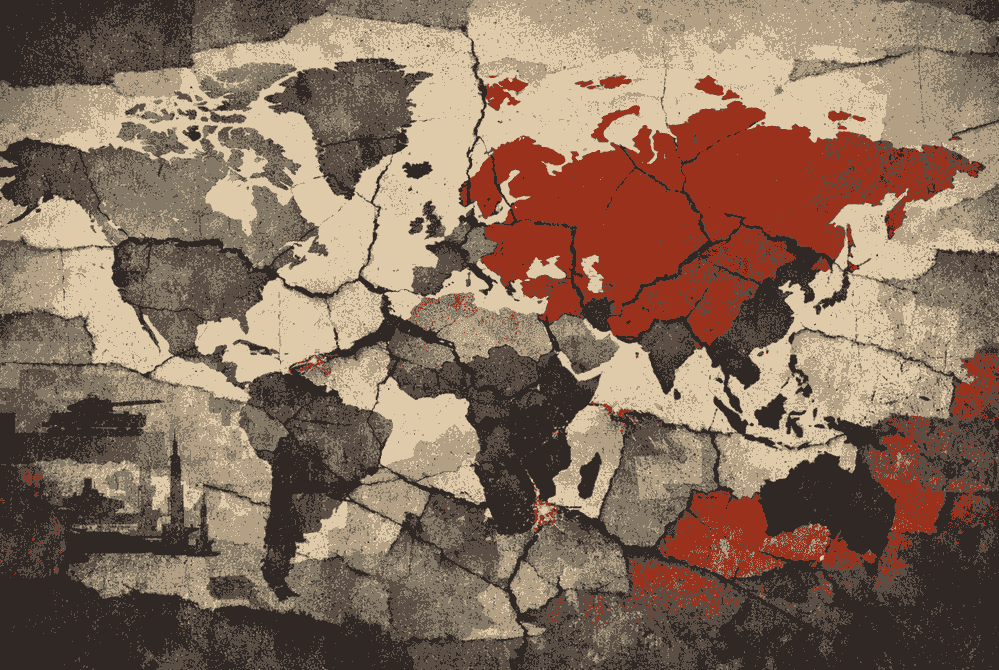
In a recent article—“The End of International Law and the Return of World War,” published January 3, 2026—Russian philosopher Alexander Dugin lays out an alarmist, deeply authoritarian vision for the global order. From a Eurasianist perspective, he asserts that international law will inevitably break down as rival power systems prove incompatible, thereby paving the way for a Third World War.
Yet this narrative serves merely as an ideological cover for Russian expansionism. Wrapped in the language of geopolitical realism, it overlooks the imperial nature of Moscow’s maneuvers and champions an authoritarian version of multipolarity. Far from being a force for liberation, this concept acts as a theoretical blueprint for dominating people whose only desire is to live peacefully in their homelands.
Alexander Dugin—a figure known for his ties to Vladimir Putin’s regime and as a central intellectual of the Russian far right (often described as “Russian fascism”)—sketches a selective history of international law. His account starts with the 1648 Westphalian system, progresses through the bipolar era of the Cold War, and culminates in the post-1991 “unipolar moment.” In this phase, he argues, the West under U.S. leadership enforced its hegemony via globalization and through institutions like the UN, which he considers outdated.
Up to this point, his analysis might resonate with decolonial critiques from the Global South, for instance, those from Latin America that challenge coloniality, extractive practices, and U.S. interventionism. Yet Dugin makes a sharp reactionary pivot: he champions a form of multipolarism founded on “civilization-states” (e.g., Russia, China, India), in which sovereignty is asserted and validated by raw power.
This perspective is not only hypocritical but dangerous. While Dugin bemoans the present “chaos” created by five clashing systems (ranging from the UN’s nominal sovereignty to U.S. unilateral hegemony), he conveniently sidesteps Russia’s own role in fostering that disorder. The 2022 invasion of Ukraine—which he openly supports—was a blatant violation of international law, including the UN Charter, which he himself dismisses as obsolete. What becomes of the sovereignty of peoples when Russian tanks level Ukrainian cities on the specious grounds of “denazification”?
This is no inevitable clash of poles, but imperial aggression mirroring the very colonialism it denounces in the West. We in Latin America know disguised interventions all too well: from Chile’s 1973 coup to recent maneuvers in Venezuela, where powers like the U.S. and Russia scramble for resources, treating our peoples as nothing but “zones of influence”—exactly as Dugin disdainfully frames them.
Moreover, Dugin’s vision of multipolarism is not progressive or decolonial, but rather authoritarian and patriarchal. Shaped by his “Fourth Political Theory” (an amalgam of National Bolshevism, Eurasianism, and fascist tropes), it advocates for a world fractured into civilizational blocks wherein cultural diversity is merely reconfigured into rigid hierarchies of power. This framework dismisses border-crossing movements for feminism, socio-environmental justice, and human rights.
At a time when the climate crisis and global inequality call for robust multilateral cooperation, Dugin chooses confrontation instead, predicting that 2026 will be a “critical” year for a protracted war. Isn’t this a self-fulfilling prophecy that benefits regimes like Putin’s, which instrumentalize anti-Western rhetoric to legitimize internal repression and external expansionism?
Sadly, Dugin’s rhetoric finds a willing audience in an authoritarian, dogmatic left. So obsessed with anti-Western “anti-imperialism,” it backs figures like him and regimes like Putin’s. Trapped in a simplistic binary worldview, they disregard human rights violations perpetrated by Russia or China, placing geopolitical alignment above the core principles of social liberation and international solidarity. This shows how deeply lost this tendency is: it mimics the very authoritarianism it claims to resist, crippling any real transformative agenda for the Global South.
Through a Latin American lens, as articulated by Aníbal Quijano and his concept of the coloniality of power, we must reject the false dichotomy posited between Western unipolarism and an authoritarian multipolar order. The real path is to challenge all imperialisms, transform the UN so the Global South is heard, demilitarize diplomacy, and put ecological survival above might-makes-right politics. Dugin’s vision provides no such path forward; it merely supplies pretexts for escalating violence.
Amid crises like the recent violence in Venezuela and Iran—where hypocrisy from both left and right is rampant— we urgently need a consistent moral stance: condemning imperialism in all its forms, be it from Washington, Moscow, or Beijing. It is solely on this foundation that a pluriversal world order, capable of accommodating a multiplicity of worlds, can be constructed —a vision diametrically opposed to the global wars Dugin appears to crave.


