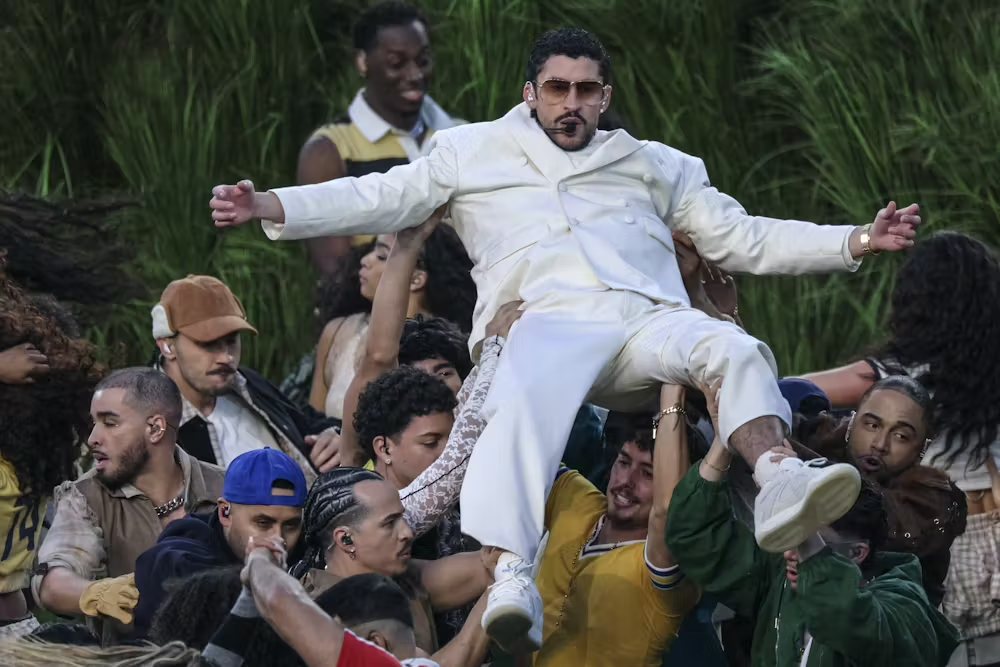
Public debates on migration are increasingly shaped not by policy analysis or institutional accountability, but by cultural influence.
Popular artists now play a central role in defining moral narratives around migration, often framing the issue in ways that are emotionally compelling but structurally incomplete.
My criticism of Bad Bunny is not musical; it is about what this form of cultural messaging represents and the consequences it has for public understanding.
Much of contemporary celebrity activism portrays migration primarily as a reaction to U.S. immigration enforcement. This framing resonates with audiences and circulates easily across social media. Yet it risks obscuring the deeper and more persistent forces that displace millions of people across Latin America and the Caribbean long before migrants reach the U.S. border.
According to the United Nations High Commissioner for Refugees and the World Bank, authoritarian governance, systemic corruption, organized crime, economic collapse, and long-term institutional failure remain the primary drivers of regional displacement (UNHCR, 2023; World Bank, 2022).
Migration does not begin at the border; it begins when states fail to provide security, economic opportunity, and political accountability. When governments cannot uphold the rule of law or protect basic rights, emigration becomes a survival strategy rather than a choice. Any serious analysis of migration that neglects these internal conditions risks misunderstanding both the nature of the problem and the effectiveness of proposed solutions.
My perspective is shaped by lived experience.
As a Cuban exile, I feel genuine solidarity with migrants seeking safety and opportunity.
Migration is not an abstract policy debate for me. However, I do not blame the country that received me. I assign responsibility to the Cuban dictatorship that made departure a necessity rather than an option.
Human rights organizations have consistently documented how political repression and economic mismanagement in Cuba have driven sustained waves of emigration for decades (Human Rights Watch, 2023). Clarity about responsibility matters because when accountability is displaced outward, the systems that generate displacement evade scrutiny.
Another underexamined dimension of migration is the role of transnational criminal organizations that exploit migration flows.
Smuggling and trafficking networks operate along migration routes and in destination cities, profiting from extortion, sexual exploitation, forced labor, and narcotics trafficking.
Law enforcement agencies and regional security reports have documented how these groups prey on vulnerable migrants and use migration corridors to expand their operations. These realities complicate migration policy and humanitarian response, yet they are rarely central to celebrity-driven narratives.
Migration is a multidimensional crisis shaped by governance failure, economic exclusion, criminal predation, and regional instability. Addressing it responsibly requires intellectual honesty, shared responsibility across nations, and the willingness to confront uncomfortable truths across ideological lines
Instead, public discourse often reduces migration to a binary moral framework in which enforcement institutions are portrayed as the primary villains. This framing overlooks a fundamental reality: states have a legitimate responsibility to enforce immigration law, protect public safety, and disrupt criminal exploitation.
Ignoring these responsibilities does not protect migrants; it leaves them more exposed to abuse and criminal control. Effective migration policy requires both compassion and order.
This dynamic reflects a broader phenomenon of cultural populism—the conversion of political grievance into commercially successful symbolism. Artists with large U.S.-based audiences can profit from narratives of symbolic rebellion that carry minimal personal or economic cost.
Political slogans and stage imagery generate visibility and loyalty, while deeper structural debates about governance reform, corruption, and authoritarianism remain largely absent.
Artistic political expression is neither new nor inherently problematic. Cultural figures have historically contributed to social debate and social change. The concern arises when public influence is accompanied by selective moral scrutiny. When democratic institutions are routinely condemned while authoritarian regimes and criminal networks receive limited criticism, public understanding becomes distorted.
Migration is a multidimensional crisis shaped by governance failure, economic exclusion, criminal predation, and regional instability. Addressing it responsibly requires intellectual honesty, shared responsibility across nations, and the willingness to confront uncomfortable truths across ideological lines.
Cultural influence carries power, and with that power comes responsibility. Migration deserves serious discussion grounded in reality, complexity, and accountability—not narratives optimized solely for emotional resonance.
